
- Vitamin C (ascorbic acid) does react with chloramine and helps reduce it. That part is real chemistry, not marketing.
- The catch is contact time. A shower gives water only a moment against the media, so a Vitamin C stage helps reduce chloramine rather than removing it.
- Vitamin C is consumed as it works, so it depletes over the life of the cartridge.
- That is why we treat Vitamin C as one stage in a layered cartridge, and why we say "helps reduce chloramine" - never "removes."
What Vitamin C actually does with chloramine
Ascorbic acid - Vitamin C - is a recognised agent for neutralising both free chlorine and chloramine. It reacts with the disinfectant and converts it to harmless products. This is established water chemistry; ascorbic acid is used to neutralise chloramine residual in other water settings where the reaction is given enough time to complete.
So the honest starting point is that Vitamin C is not a gimmick for chloramine. It genuinely reacts with it. The real question is not whether it works, but how completely it works in the specific conditions of a shower.
The catch: contact time
A shower is the hardest place to filter water. The flow is fast and the water passes through the media in a moment, which is far less time than a slow under-sink or benchtop filter allows. Vitamin C reacts with chloramine more slowly than it reacts with free chlorine, so in that brief shower contact it reduces chloramine partially rather than completely.
This is exactly why we are careful with language. A Vitamin C stage helps reduce chloramine at shower flow. Any product claiming to "remove" or "eliminate" chloramine from a shower, or quoting a precise removal percentage, is making a claim the physics of contact time does not support.
It depletes as it works
Unlike a media that adsorbs contaminants onto its surface, Vitamin C is consumed in the reaction. It is used up over the life of the cartridge, which is one reason cartridges have a replacement schedule rather than lasting indefinitely. A depleted Vitamin C stage stops contributing, so replacing the cartridge on time matters.
The honest debate
There is a genuine disagreement in the filter world about Vitamin C for chloramine. Some argue that because the reaction is slower and contact time is short, catalytic carbon is the more reliable chloramine media for a shower. That is a fair position, and catalytic carbon is a legitimate approach. Others point out that Vitamin C is a proven dechloramination agent and a sensible stage when paired with others.
Our view sits with the evidence rather than either sales pitch: Vitamin C helps reduce chloramine, it is not a complete standalone solution at shower flow, and it earns its place as one stage in a layered cartridge rather than as the whole answer.
Why our cartridge still uses it
Eagle Reborn's cartridge does not lean on Vitamin C alone for chloramine. It sits in a layered stack - KDF-55 and calcium sulfite handle chlorine, Vitamin C is the chloramine-focused stage, and activated carbon polishes the result. The point of layering is that no single stage carries the whole load. Vitamin C contributes what it is good at, within a design that does not overstate it. For what each stage does, see What Each Shower Filter Media Stage Actually Does.
What we claim, and what we do not
Frequently asked questions
Does Vitamin C remove chloramine from shower water?
It helps reduce it. Vitamin C reacts with chloramine, but a shower's fast flow gives too little contact time for complete removal. It is a chloramine-focused stage, not a total-removal claim.
Is Vitamin C or catalytic carbon better for chloramine?
Both are legitimate. Catalytic carbon is a dedicated chloramine media; Vitamin C is a proven dechloramination agent that works best as one stage in a layered cartridge. The right choice depends on the filter design and your water.
Why does a Vitamin C shower filter need replacing?
Vitamin C is consumed as it reacts, rather than adsorbing contaminants like carbon does. It depletes over the cartridge's life, so on-time replacement keeps the stage working.
Does Vitamin C work better on chlorine or chloramine?
It reacts faster and more completely with free chlorine than with chloramine. Chloramine is the harder target, which is why contact time matters more for it.
Why do you say "helps reduce" chloramine instead of "removes"?
Because that is what the chemistry supports at shower flow. Claiming full removal or a specific percentage would overstate what any Vitamin C stage can do in the short contact time of a shower.
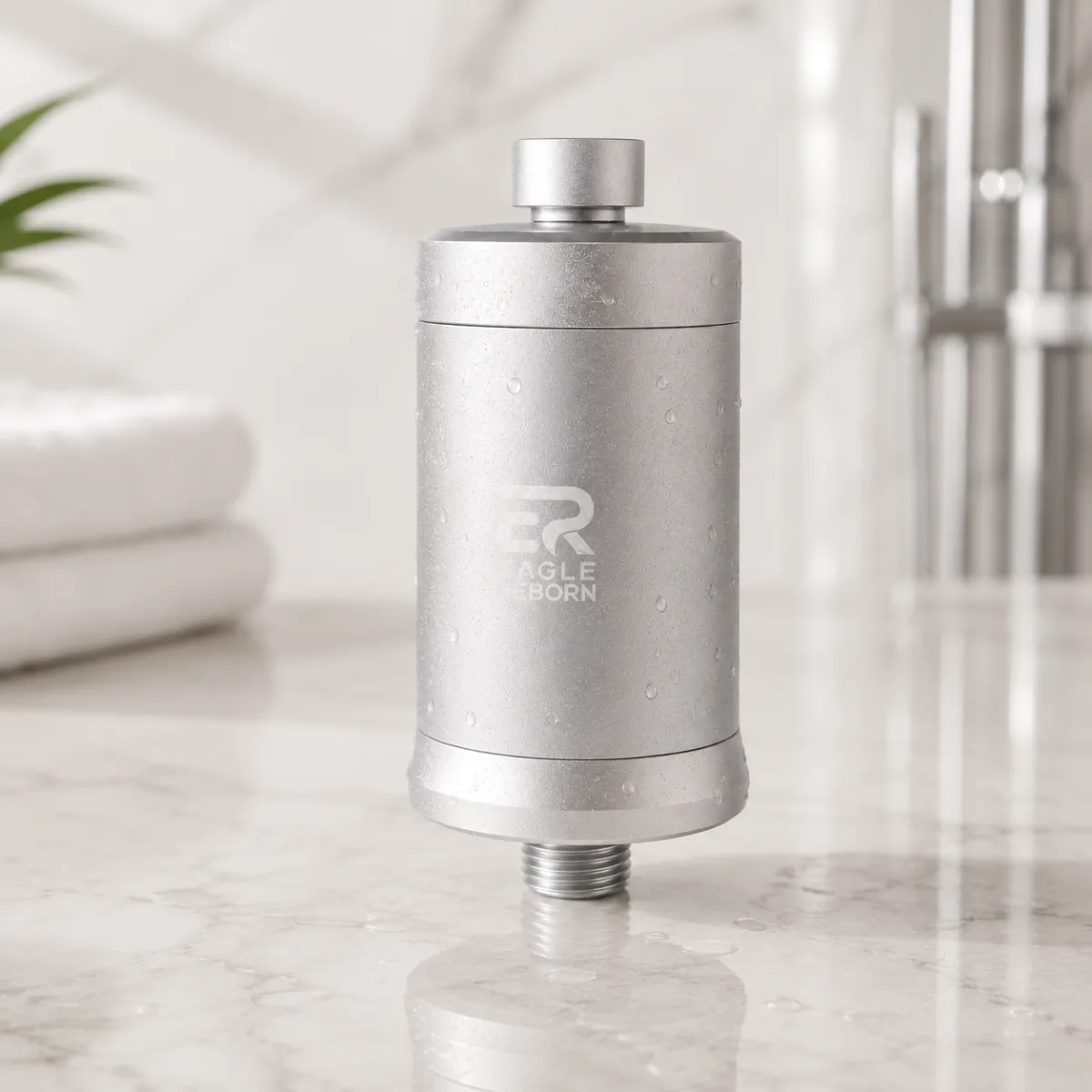
The Eagle Reborn shower filter
Anodised aluminium, four-stage layered media, full pressure retained. Designed in Australia.
Book yours nowBook now